wissen
The Sacred Genealogy of the Êzîdîs: Castes, Saints and Offices
8 verified · Wikimedia Commons · CC license
🖼 Images
Êzîdî society is built upon a religiously grounded, hereditary ordering principle: three endogamous castes, three Şêx lineages and a series of spiritual offices that trace themselves genealogically back to the holy forefathers. This article explains this structure, the principal holy figures and the offices, throughout with academic references. The proper names appear in Latin Êzdîkî/Kurmancî spelling.
Contents
- Overview: Castes and the Ordering Principle
- The Heft Sirran, the Seven Holy Beings
- The Key Figures of Salvation History
- The Three Şêx Lineages: Şemsanî, Adanî, Qatanî
- The Pîr Caste
- The Spiritual and Secular Offices
- The Mîr Dynasty
- Myth and History: how reliable are the family trees?
- Sources
1. Overview: Castes and the Ordering Principle
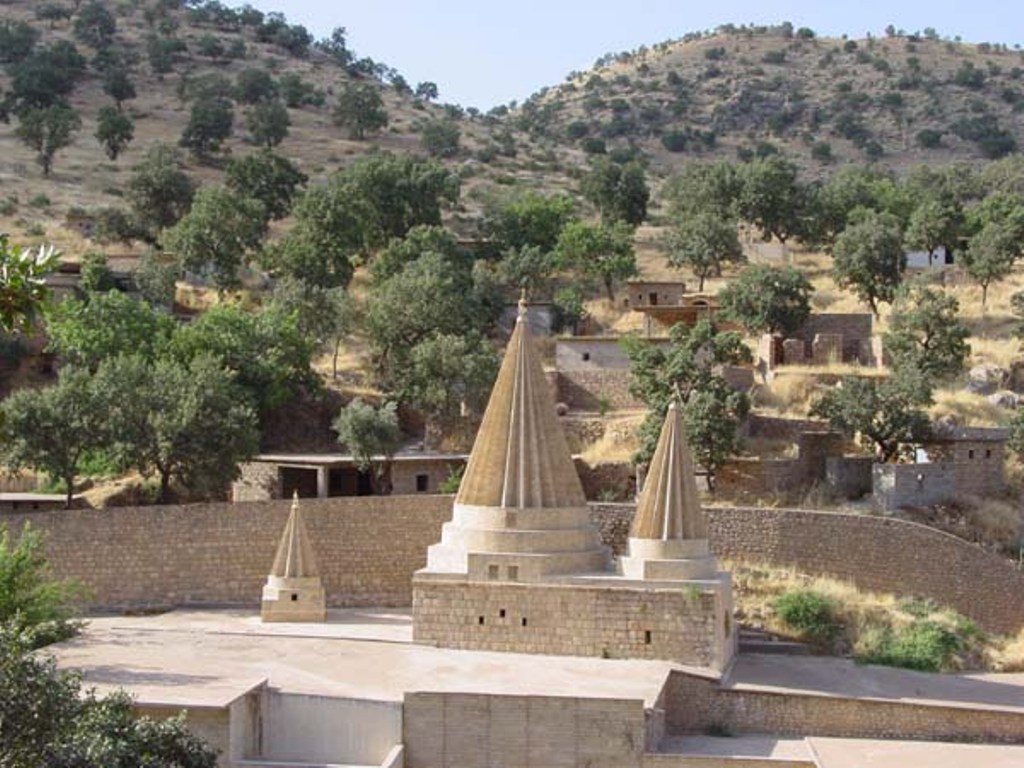
Lalîş (Şêxan, Northern Iraq): the principal sanctuary and the genealogical anchor point of all Êzîdî lineages. Here the shrines of the holy forefathers are gathered. · Photo: Ger Al Hamud Ser bahger · CC BY-SA 3.0 · Wikimedia Commons

Êzîdî society is divided into three hereditary, strictly endogamous castes. Membership is inherited from both parents and cannot be changed during one’s lifetime (Kreyenbroek 1995; Encyclopaedia Iranica, “Yazidis i. General”):
| Caste | Character | Role |
|---|---|---|
| Şêx (Sheikh) | priestly, in three lineages (Şemsanî, Adanî, Qatanî) | religious instruction, leadership of the rites, administration of the sanctuaries and of the highest offices |
| Pîr (Elder/Sage) | priestly, in numerous lineages | spiritual care, festival rites, certain spiritual functions, politically subordinate to the Şêx |
| Mirîd (Murîd, “disciple”) | lay | the great majority of the Êzîdîs; every Mirîd is genealogically assigned firmly to one Şêx and one Pîr |
Endogamy and the marriage taboo. Marriages between the three castes are forbidden and are regarded religiously as “spiritual incest”, because the bonds are understood as spiritual kinship (Iranica; Omarkhali 2017). The three Şêx lineages too may not marry one another. A violation can lead to expulsion from the community.
The five fixed relationships. Every Êzîdî stands within a web of hereditary spiritual relationships that interlock the castes with one another: a personal Şêx, a personal Pîr, a Mêrebî (spiritual mentor), a Hosta (teacher) and a Birayê/Xwişka Axretê (Brother or Sister of the Hereafter). These bonds are inherited and in principle indissoluble (ezidi-heritage.org; Kreyenbroek 1995).
How are the highest offices distributed? Each of the three Şêx lineages provides a supreme authority: the Qatanî the secular Mîr, the Şemsanî the Babê Şêx (spiritual head), the Adanî the Pêşîmam (authority over rites and marriage). This division is elaborated in Section 6 (Iranica; yazidiculturalheritage.com).
2. The Heft Sirran: the Seven Holy Beings

Tawûsî Melek, leader of the Heft Sirran, in George Percy Badger’s The Nestorians and their Rituals (1852). · Public Domain · Wikimedia Commons
.jpg)
The theological foundation of the entire sacred genealogy is the Heft Sirran (“Seven Mysteries”, also Heft Melek “Seven Angels”). According to Êzîdî doctrine, Xwedê (God) created seven holy beings out of his own light before the world and entrusted to them the governance of creation; at their head stands Tawûsî Melek, the Peacock Angel (Kreyenbroek 1995, pp. 47–92; Kreyenbroek/Rashow 2005).
Decisive for understanding the family trees is the doctrine of kiras guhorîn (“changing of the shirt”): the Seven become visible again and again throughout history in earthly saints, in whom they are understood to be present or incarnate, preferentially within the circle of the holy families (Kreyenbroek 1995; Yazidism, Wikipedia). Thereby the historical forefathers are at the same time angelic figures: Şêx Adî is regarded as the earthly manifestation of Tawûsî Melek, Şêx Hesen as that of Melik Şêxsin.
| Holy Being | Sphere / Function | Connection to the Genealogy |
|---|---|---|
| Tawûsî Melek | leader of the Seven; God’s vicegerent, mediator between God and humankind; “Bavê Pîran” (Father of the Pîrs) | manifesting earthly in Şêx Adî |
| Şêx Şems | Lord of sun, light and fire | patron of the Şemsanî lineage; son of Êzdîna Mîr |
| Şêx Fexredîn | Lord of the moon; scribe of the sacred hymns; protection of family and home | son of Êzdîna Mîr; from his lineage comes the Babê Şêx |
| Şêx Sicadîn | guide of souls into the hereafter (psychopomp) | son of Êzdîna Mîr |
| Şêx Nasirdîn | angel of death and renewal | son of Êzdîna Mîr |
| Melik Şêxsin (= Şêx Hesen) | Lord of writing and learning | patriarch of the Adanî lineage |
| Şêxûbekir (Şêx Obekr) | one of the Seven Beings | patriarch of the Qatanî lineage |
Convention. The Êzîdîs often do not name Tawûsî Melek directly, but circumscribe him as Padîşah or Melek. Tawûsî Melek is not to be confused with the Devil, this equation by outsiders is a misinterpretation that historically contributed to the persecution of the Êzîdîs. Concerning the inner secrets of the Seven (the Heft Sirr in the narrower, esoteric sense) there is a taboo of silence; this article reports only what is openly treated in published scholarship.
The three central salvific figures, Tawûsî Melek, Şêx Adî and Sultan Êzî: are sometimes described in scholarship as three aspects of the one God, whose identities merge into one another (Rodziewicz 2014/2016; Yazidism, Wikipedia).
3. The Key Figures of Salvation History
3.1 Şêx Adî ibn Musafir (ca. 1075–1162)

Conical shrine spire of Şêx Adî in Lalîş. · CC BY-SA 4.0 · Wikimedia Commons

Şêx Adî (Şîxadî) is the central historical figure. He was born around 1075 in the Beqaa Valley (Lebanon), descended from the Umayyad clan and was a Sunni Sufi of the Šāfiʿī school. In Baghdad he studied in the circle of important mystics (among them ʿAbd al-Qādir al-Jīlānī, the founder of the Qādiriyya); around 1115 he withdrew into the remote valley of Lalîş and founded there the Sufi order of the Adawiyya. He died in 1162 in Lalîş, where his tomb remains to this day the most important sanctuary of the Êzîdîs (Wikipedia, “Adi ibn Musafir”; Açıkyıldız 2010, ch. 2; Kreyenbroek 1995, pp. 27–44).
Important for the historical understanding: the writings reliably attributed to him are strictly Islamic and contain no specifically Êzîdî theology (Kreyenbroek 1995, p. 30; Açıkyıldız 2010). The historical Şêx Adî was an orthodox Sufi. The independent Êzîdî religion took shape only several generations later under his successors, through the fusion of the Adawiyya with the older, pre-Islamic religion of the region (Kreyenbroek 1995, ch. 2; Spät 2005). For the Êzîdîs, Şêx Adî is regarded as the earthly manifestation of Tawûsî Melek.
The “holy books”. The texts known under the titles Kitab al-Jilwa and Mishefa Reş are regarded in scholarship predominantly as late compilations, partly composed in the 19th century, and not as original revelatory scriptures (Kreyenbroek 1995, pp. 10–15; Iranica). The authentic religious tradition of the Êzîdîs is oral: the Qewl (hymns), which are sung by the Qewwal and have only been systematically written down since the 1970s (Omarkhali 2017).
3.2 Êzdîna Mîr: Patriarch of the Şemsanî
Êzdîna Mîr is regarded as the last Êzîdî ruler before the arrival of Şêx Adî (early 11th century) and as the forefather of the Şemsanî lineage. His four sons, Şêx Şems, Fexredîn, Sicadîn and Nasirdîn: became at the same time four of the Heft Sirran (Açıkyıldız 2010, p. 79; yazidiculturalheritage.com; ezidi-heritage.org). With him is associated the older, Kurdish-Iranian stratum of the tradition, while Şêx Adî introduced the Arab-Sufi strand; the synthesis of both yields the Êzîdî religion (Kreyenbroek 1995).
3.3 Şêx Hesen / Melik Şêxsin (1195–1254): Patriarch of the Adanî
Şêx Hesen (theologically Melik Şêxsin) was a grand-nephew of Şêx Adî (through his nephew and successor Sakhr Abu l-Barakat and Şêx Adî II). He is regarded as the “Master of the Pen”, patron of writing and learning; from him is derived the Adanî lineage, which traditionally was the only Êzîdî group to cultivate reading and writing. In 1254 he was executed on the order of the Atabeg of Mosul, Badr al-Dīn Luʾluʾ, together with about 200 followers, the beginning of the documented history of persecution (Wikipedia, “Sheikh Hasan ibn Sheikh Adi II”; Kreyenbroek 1995, p. 30; Açıkyıldız 2010). He too is a dual figure: a historical person and the earthly manifestation of the angel Melik Şêxsin.
3.4 Şerfedîn (d. 1257/58)

Shrine of Şerfedîn in the Şingal mountains near Sinune (Sinjar). Severely damaged in 2014–2017 by the IS genocide, under reconstruction since 2019. · Photo: Levi Clancy · CC0 · Wikimedia Commons

Şerfedîn, the son of Şêx Hesen, reorganised the movement after the catastrophe of 1254. He fell in 1257/58 during the Mongol invasion. In the tradition he is regarded as the “personification of the Êzîdî religion”; from his lineage the office of the Pêşîmamê Babê Şêx is filled to this day (Wikipedia, “Yazidis”, “Sheikh Hasan…”; Kreyenbroek 1995, pp. 30–34; Açıkyıldız 2010).
3.5 Sultan Êzî / Êzîdê Sor: Salvific Figure and Scholarly Debate

Entrance to the courtyard of the main Lalîş temple. · Photo: Levi Clancy · CC BY-SA 4.0 · Wikimedia Commons

Sultan Êzî (also Êzîdê Sor, “the red Êzî”) is one of the central salvific figures and the eponym of the Êzîdîs. Regarding his origin there is a well-known scholarly debate:
- Historical reading: Êzî goes back to the Umayyad caliph Yazīd I (r. 680–683); the Adi lineage is said to have brought his veneration along (so the older Western scholarship; Kreyenbroek 1995, p. 28).
- Theological reading: Êzî derives from the Old Iranian yazata (“being worthy of veneration”); Sultan Êzî is an independent divine angel with no historical Yazīd connection (so the present-day self-understanding of many Êzîdîs).
- Synthesis: an older, pre-Islamic yazata stratum was later overlaid by the Yazīd connection; today the Old Iranian-theological functions predominate (Açıkyıldız 2010; Rodziewicz 2016; Asatrian/Arakelova 2014).
In the triad described by Rodziewicz, Sultan Êzî forms, together with Tawûsî Melek and Şêx Adî, the three aspects of the one God. His festival is the Cêjna Êzî (winter festival); his shrine stands in Lalîş.
4. The Three Şêx Lineages: Şemsanî, Adanî, Qatanî
The Şêx caste is divided into three lineages that do not marry one another and each carry a forefather and a supreme function (yazidiculturalheritage.com; Iranica; Wikipedia, “Yazidi social organization”):
| Lineage | Forefather | Origin (tradition) | Provides the office | Historical role |
|---|---|---|---|---|
| Şemsanî | Êzdîna Mîr (through his 4 sons) | Kurdish | Babê Şêx (through the Fexredîn family) | oldest, pre-Adi stratum |
| Adanî | Şêx Hesen / Melik Şêxsin | Arab | Pêşîmam | learned, literate stratum |
| Qatanî | Şêxûbekir (relative of Şêx Adî) | Arab | Mîr | secular leadership lineage |
A nuance in the sources. Some sources (yazidiculturalheritage.com, Iranica) say in shortened form that the Qatanî descend “from Şêx Adî”. Since Şêx Adî, however, died childless, the more precise formulation is: the Qatanî trace themselves back to Şêxûbekir, who is regarded as a relative or companion of Şêx Adî (ezidi-heritage.org; Açıkyıldız 2010). Through the later Pismîr lineage, the secular Mîr dynasty emerged from the Qatanî (see Section 7).
The four sons of Êzdîna Mîr (Şemsanî). From Şêx Şems comes the Şemsedîn lineage, from Fexredîn the Fexredîn lineage, from which the Babê Şêx is chosen. Sicadîn and Nasirdîn are venerated above all theologically as angels.
Female Şêx saints. The tradition also knows significant female saints: foremost Xatûna Fexra (daughter of Fexredîn), patroness of birth and pregnancy and one of the most important female cult sites, as well as Sitt Nefîse (healing) and several daughters of Şêx Şems.
5. The Pîr Caste
The term Pîr (“Elder, Sage”) designates the second priestly caste alongside the Şêx. The tradition ideally counts forty principal lineages (“Çelî Pîr”); historically, however, considerably more sub-lineages are documented (ezidi-heritage.org; yazidiculturalheritage.com). To each Mirîd family exactly one Pîr is assigned, hereditarily and indissolubly.
Tasks of the Pîr. Spiritual care of the assigned Mirîd families, participation in festivals and rites of passage, annual visits for blessing (with bread and salt) and for the receipt of the religious due; relative to the Şêx they have a lesser political standing (Iranica; ezidi-heritage.org).
Marriage taboo of the Pîr. Pîrs may not marry into: the lineages of their own Mirîds, the lineage of their own Pîr/mentor, as well as lineages that are spiritually subordinate to them (ezidi-heritage.org; Kreyenbroek 1995).
Significant Pîr lineages (a selection, with well-documented functions):
| Pîr lineage | Sphere / Function |
|---|---|
| Pîr Hesen Meman | the highest of the Pîrs, “Pîr of the forty Pîrs”; close companion of Şêx Adî |
| Pîr Mehmed Reşan (Mem Reşan) | “Lord of the rain”; patron of harvest and agriculture; shrines on the Sinjar and in Lalîş |
| Pîr Sînî Bahrî | “Lord of the sea”; associated with his lineage is the Mişûr document (604 AH / 1207–08), one of the earliest dated Êzîdî texts (Iranian Studies 53, 2019) |
| Pîr Omerxala | patriarch of the Mêrebî (the spiritual mentors) |
| Pîr Mehmedê Reben | Lalîş administrative lineage; from it comes the Baba Çawîş |
6. The Spiritual and Secular Offices

Tomb complex of Şêx Adî in Lalîş (1981). · CC BY 3.0 · Wikimedia Commons

The religious constitution of the Êzîdîs distributes the supreme offices genealogically across the three Şêx lineages and supplements them with service offices that are also filled from the Pîr or Mirîd caste (Iranica; yazidiculturalheritage.com; Wikipedia, “Yazidi social organization”):
| Office | Lineage / Origin | Function |
|---|---|---|
| Mîr (Mîrê Êzîdxanê) | Qatanî | secular and representative head; appoints the Babê Şêx; represents the community externally; leads the Spiritual Council |
| Babê Şêx | Şemsanî (Fexredîn family) | spiritual head; present at all major rites; highest purely religious authority |
| Pêşîmam | Adanî (descendant of Şêx Hesen) | authority for marriage and ceremonial law; concludes marriages and regulates bride-price |
| Baba Çawîş | lineage of Pîr Mehmedê Reben | guardian and administrator of the sanctuary of Lalîş |
| Qewwal | Mirîd tribes (Dimilî and Tazhî), trained by Adanî Şêx | religious singers; recite the Qewl, carry the banner (Sancak) of Tawûsî Melek on the processional rounds and thus preserve the oral tradition |
| Feqîr | from several castes | ascetics who dedicate their lives to the faith; a model of piety and abstinence |
| Koçek | servants of Lalîş, under the Babê Şêx | “seers” with an attributed gift of vision; serving function at the sanctuary |
Sources on the offices: ezidi-heritage.org; yazidiculturalheritage.com; Iranica; Wikipedia, “Yazidi social organization” (as of 2026: the incumbent Babê Şêx is Şêx Alî Ilyas, since November 2020).
7. The Mîr Dynasty
The Mîr have been the secular supreme authority of the Êzîdîs since the 16th century; they belong to the Qatanî lineage and are regarded in the tradition as legitimate successors of Şêx Adî. Genealogically the lineage traces back through Şêx Mehmedê Batinî and the Pismîr branch (Wikipedia, “Sheikhan principality”; ezidi-heritage.org). From the 16th to the early 18th century the principality of Şêxan was administered as an Ottoman administrative district; the princes often bore the byname “Dasinî” (an old regional name and synonym for “Êzîdî”).
The dynasty is thoroughly marked by persecution, only a few Mîrs died a natural death (ÊzîdîPress). Important milestones:
| Mîr | Period | Note |
|---|---|---|
| Mîr Hussein Beg Dasinî | until ~1530s | installed in the Sanjak of Mosul 1534; murdered |
| Mir Ali Beg I “the Great” | 1809–1833 | killed in the Rawanduzi massacre (1832) |
| Mir Ali Beg II | 1899–1913 | married to Mayan Khatun (1873–1956), de facto regent in the 1920s–30s |
| Mir Said Beg | 1913–1944 | murdered in 1944 |
| Mir Tahsin Beg | 1944–2019 | longest tenure (75 years); in 2014 called on the world for help against the IS genocide; d. 2019 in Hanover |
| Mir Hazim Tahsin Beg | since 2019 | incumbent Mîr (Qatanî); election by the KRG authorities disputed, in parts of Sinjar an alternative Mîr is recognised |
Sources: Wikipedia, “Sheikhan principality”, “Tahseen Said”, “Hazim Tahsin Beg”; ÊzîdîPress, “The Last Mîr”. Mayan Khatun is regarded as the only documented case of a female de facto leadership and as one of the formative figures of recent Êzîdî history.
8. Myth and History
The sacred genealogy of the Êzîdîs combines two levels that ought to be kept apart:
- a theological level, on which the forefathers are at the same time angels of the Heft Sirran (kiras guhorîn), and
- a historical level with datable persons of the 11th–13th centuries (Şêx Adî, Şêx Hesen, Şerfedîn).
Scholarship emphasises that the genealogical tradition lives primarily in the Qewl: oral, sung, theologically shaped, and must not be read as a historical archive (Kreyenbroek 1995; Omarkhali 2017; Allison 2001). Precisely the earlier generations and the exact kinship relations are in part uncertain; the tradition conflates, for instance, Şêx Adî II with the angelic figure Melik Şêxsin. Where sources diverge from one another, as with the origin of the Qatanî, this is not a contradiction within the tradition, but an expression of this dual nature of myth and history. The oral tradition remains the actual authority; reliable deepening proceeds via the Qewwal and the critical text editions of scholarship.
9. Sources
Principal scholarly works
- Kreyenbroek, Philip G.: Yezidism, Its Background, Observances and Textual Tradition. Lewiston: Edwin Mellen Press, 1995. (foundational work on theology, Heft Sirran, Şêx Adî)
- Kreyenbroek, Philip G. & Rashow, Khalil J.: God and Sheikh Adi are Perfect, Sacred Poems and Religious Narratives from the Yezidi Tradition. Wiesbaden: Harrassowitz, 2005. (Qewl edition)
- Omarkhali, Khanna: The Yezidi Religious Textual Tradition: From Oral to Written. Wiesbaden: Harrassowitz, 2017. (textual history, Mişûr, clan structure)
- Açıkyıldız, Birgül: The Yezidis: The History of a Community, Culture and Religion. London: I.B. Tauris, 2010. (cultural history, family trees)
- Allison, Christine: The Yezidi Oral Tradition in Iraqi Kurdistan. Richmond: Curzon, 2001. (oral tradition)
- Asatrian, Garnik & Arakelova, Victoria: The Religion of the Peacock Angel: The Yezidis and Their Spirit World. Yerevan/Durham: Acumen, 2014.
- Spät, Eszter: The Yezidis. London: Saqi Books, 2005.
- Rodziewicz, Artur: “The Holy Trinity of the Yazidis…”, in Iran and the Caucasus (2014 ff.); collected volume Yazidism: Historical and Theological Roots, Harrassowitz 2019.
- Kreyenbroek, P. G. & Allison, C.: “YAZIDIS i. GENERAL”, in Encyclopaedia Iranica (Online). iranicaonline.org
- “A Yezidi Manuscript: Mišūr of Pîr Sīnī Bahrī / Pîr Sīnī Dārānī”, in Iranian Studies 53/1–2 (2019). tandfonline.com
Community and web sources
- Ezidi Heritage: “Ezidi Caste System: Şêx, Pîr & Mirîd”. ezidi-heritage.org
- Yazidi Cultural Heritage: “Society”. yazidiculturalheritage.com
- ÊzîdîPress: “The Last Mîr”. ezidipress.com
- Wikipedia: Yazidism · Tawûsî Melek · Adi ibn Musafir · Sheikh Hasan ibn Sheikh Adi II · Yazidi social organization · List of Yazidi holy figures · Sheikhan principality · Sultan Ezid
3. Cosmology of the Seven and the Divine Triad
Section 2 introduced the Seven as persons. Yet they are at the same time a cosmological system: a model of how God brings forth the world, orders it, and remains present within history. This section summarizes what the published research openly presents on this matter.
3.1 Creation from the Pearl (Dur)
According to the Qewl, before the world only Xwedê (God) existed, who out of his own light (Ronahî) created a white pearl (Dur, also Durr “pearl”) and dwelt within it. From this pearl the created world emerged; in several hymns the pearl rests on the horns of a bull standing upon a fish, an image the Yazidis share with neighbouring ancient Near Eastern cosmologies (Kreyenbroek 1995; Yazidism, Wikipedia; Tawûsî Melek, Wikipedia).
From the divine essence that the Yazidis call Sur (also Sirr, “secret, mystery, essence”), the Seven emerge as the first emanations. Tawûsî Melek is understood here as the being that has immediate access to God’s Sur, at times as the first emanation of the Sur altogether (Rodziewicz 2018, Heft Sur). God entrusts the Seven with “all the affairs of the world”; they are thus not God himself, but his governance within creation, a model that scholarship describes as uniplural: a single supreme being that manifests in seven distinct yet connected forms.
3.2 The Seven as a Threefold Manifestation: Angels, Planets, Saints
What is distinctive about the Yazidi system is that the same number seven appears on three levels. According to Rodziewicz, the seven angels are at once the seven planets of the older astral religion and the seven holy patriarchs of the earthly genealogy, all of them manifestations of the one Sur:
| Level | Appearance of the Seven |
|---|---|
| cosmic | the seven angels / Heft Sirran, headed by Tawûsî Melek |
| astral | the seven planets of the region’s pre-Islamic astral cults |
| earthly-genealogical | the seven holy patriarchs (Şêx Şems, Fexredîn, among others, see Section 2) |
It is precisely here that the doctrine of kiras guhorîn (“changing the shirt”, Section 2) applies: the Seven “change their shirt”, appearing over time in ever-new earthly bearers. As a result, the holy genealogy is not a mere family tree, but the historical becoming-visible of an eternal cosmic blueprint.
Harranian trace. Rodziewicz traces the motif of the Seven Angels back to the late-antique “Sabians” of Harran (a blend of Platonic and local astral traditions). After the destruction of their temples, the last representatives of this group may have migrated into the region of Mardin and Mosul and merged into the Yazidi community taking shape there between the 12th and 14th centuries (Rodziewicz 2018). This is a research hypothesis on the origin of the motif, not an article of Yazidi faith.
3.3 The Divine Triad: Tawûsî Melek – Şêx Adî – Sultan Êzî
It was already mentioned in §2 (conclusion) and §3.5; here is the doctrine of incarnation in context. The Polish religious scholar Artur Rodziewicz describes a divine triad (which he calls the “Holy Trinity of the Yazidis”), in which three figures are understood as three hypostases of the one God (Rodziewicz 2014, Iran and the Caucasus; Yazidism / Sultan Ezid, Wikipedia):
- Tawûsî Melek, the Peacock Angel, leader of the Seven and viceregent of God;
- Şêx Adî ibn Musafir, the second hypostasis, the historical reformer figure (see §4.1);
- Sultan Êzî (Êzîdê Sor), the third hypostasis and the namesake of the Yazidis (see §4.5).
The core of the doctrine of incarnation: the identities of these three pass into one another. Şêx Adî is regarded as an incarnation of Tawûsî Melek (and conversely Tawûsî Melek becomes visible in Şêx Adî); the same applies to Sultan Êzî, who can likewise be identified with Tawûsî Melek. In this reading Tawûsî Melek appears as the first emanation of the divine Sur, which has manifested historically in Yazīd ibn Muʿāwiya (→ Sultan Êzî) and in Adi ibn Musafir (Rodziewicz 2014/2018). The triad is therefore not polytheism, but the Yazidi way of expressing the one divine working in several faces, and the genealogical counterpart to the cosmological doctrine of the Seven.
Contextualization. “Triad/Trinity” is an analytical term of scholarship (Rodziewicz), not an official dogma with a fixed wording. The Yazidis themselves transmit these connections in the Qewl and are bound to silence regarding the inner mysteries of the Sur (Section 2). Tawûsî Melek is and remains the good, supreme angel of God, never a devil.
Kommentare
Noch keine Kommentare — sei der Erste.